
The transposition of the EU's Renewable Energy Directive (RED III) into Irish law in August 2025 has changed the planning timeline for solar farm developments — with direct consequences for the timing and scope of archaeological geophysical survey.
What has changed?
The European Union (Planning and Development) (Renewable Energy) Regulations 2025 (S.I. 274 of 2025) introduced mandatory decision-making timelines for renewable energy planning applications: 52 weeks for developments with a capacity of ≥150kW, and 30 weeks for smaller developments and repowering. A completeness check must be carried out within 45 days of receipt — incomplete applications are returned.
These timelines cannot be paused for further information requests or environmental assessments.
The Regulations create distinct development categories with different rules:
- "Renewable energy development" covers most ground-mounted solar farms on agricultural land (52-week decision period). Further information can still be requested, but must be issued within 8 weeks of the completeness check notice, with a fixed response deadline. If the applicant fails to respond in time, the application is deemed withdrawn. The decision clock runs throughout.
- "Relevant solar energy development" covers solar on existing or future artificial surfaces — rooftops, car parks, etc. (8-week decision period). Further information requests have been disapplied entirely for this category, along with small-scale solar and heat pumps (confirmed in Circular CEPP 1/2025, 15 August 2025).
What does this mean for archaeological survey?
Under the previous regime, planning authorities commonly requested additional archaeological information post-submission, and developers could lodge applications with a commitment to undertake geophysical survey or test trenching as a condition. That approach is now considerably more difficult. The compressed timescales and non-stopping decision clock leave no scope to pause for lengthy additional fieldwork. An inadequate archaeological submission is likely to result in refusal or an unachievable remediation deadline.
This was illustrated in July 2025 when Cork County Council refused permission for a 100MW, 161-hectare solar farm at Aglish, citing insufficient archaeological investigation. The applicant argued that a shortage of geophysical survey capacity in Ireland and the fast-tracking of permitting for renewables should override heritage concerns. The planning authority rejected that argument. While this decision predated S.I. 274, it demonstrates that authorities will refuse where archaeological assessment is inadequate — a position the new regime makes more consequential.
The overriding public interest presumption
RED III required (from February 2024) that renewable energy projects be presumed to serve an overriding public interest when balancing competing legal interests. Ireland transposeby adding a new subsection to this in August 2025 through a new subsection in section 177AA of the Planning and Development Act 2000. However, this presumption has a narrow scope — it applies within the appropriate assessment process under the Habitats Directive, which deals with potential impacts on European-designated conservation sites (SACs and SPAs). It does not extend to archaeological heritage, which is protected under separate legislation — principally the National Monuments Acts and the EIA Directive. Developers should not interpret the "overriding public interest" presumption as reducing the requirement for archaeological assessment.
EIA requirements
"Relevant solar energy development" and certain solar repowering projects are exempted from EIA/EIA screening under section 172 of the 2000 Act. Ground-mounted solar farms on greenfield land are not — they remain subject to EIA screening and, where thresholds are met, full EIA. EIA scoping is becoming mandatory for renewable energy developments: An Coimisiún Pleanála applied this to strategic infrastructure applications from 1 October 2025, with EIA opinion provisions for planning authority applications expected from 1 May 2026. Once a scoping opinion is provided, the scope cannot subsequently be extended — locking in the assessment parameters early.
Renewables acceleration areas
By February 2026, Member States must designate renewables acceleration areas (RAAs) with simplified approval procedures and potentially reduced prior survey requirements. Ireland has not yet designated any. Archaeological sensitivity mapping may eventually be incorporated at the area level, but the interaction with existing heritage protections is undefined. Developers should not assume RAA designation will eliminate site-specific assessment requirements.
Practical recommendations
Use pre-application consultation. Circular CEPP 1/2025 emphasises that applicants should use this process to agree completeness check requirements with the planning authority, including the scope of archaeological assessment. For SID applications to An Coimisiún Pleanála, pre-application consultation must be completed before mandatory EIA scoping can be requested.
Commission archaeological work early. Geophysical survey, desk-based assessment, and any required test trenching should be scheduled well in advance of the application date. The compressed post-submission timescales make it impractical to undertake substantial additional fieldwork after lodging.
Allow for the full programme of work. Before fieldwork can begin, a detection device licence must be obtained from the NMS — typically 4-week turnaround. Following completion of the survey, the data must be processed and interpreted, and the results incorporated into a Heritage or Archaeological Impact Assessment chapter. Each of these stages takes time and is sequential. Working backwards from a target application date, the geophysical survey element alone may need two to three months of programme time from initial instruction to deliverable report, depending on size.
Consider the full assessment sequence. Geophysical results may indicate the need for targeted test trenching to characterise anomalies before submission. Build in contingency.
Engage with the NMS early. Their recommendations carry weight with planning authorities, and early engagement helps define the scope of required assessment.
Secure survey capacity. There is acknowledged pressure on geophysical survey capacity in Ireland. Early contractor engagement reduces the risk of programme delays.
How we can help
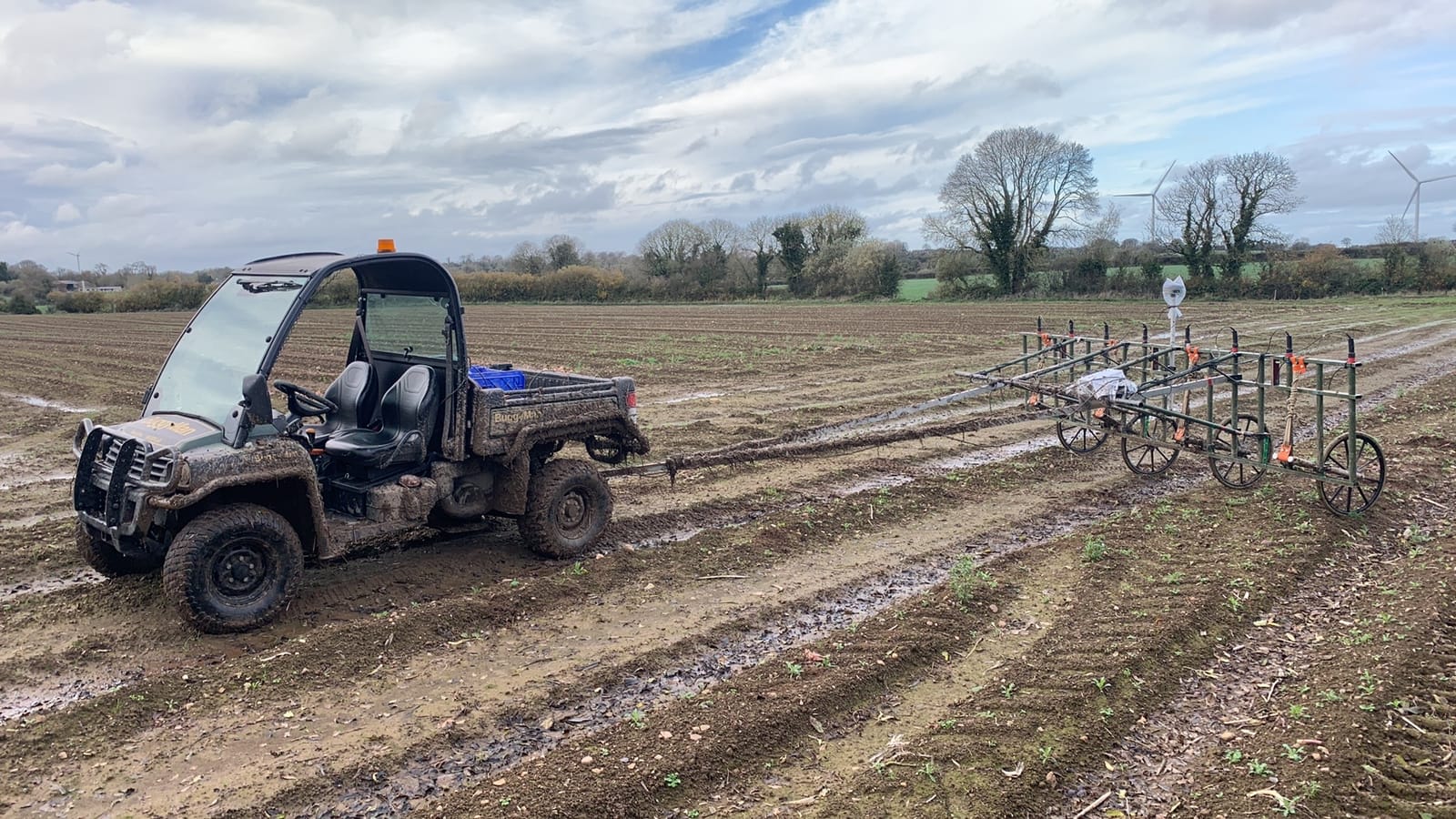
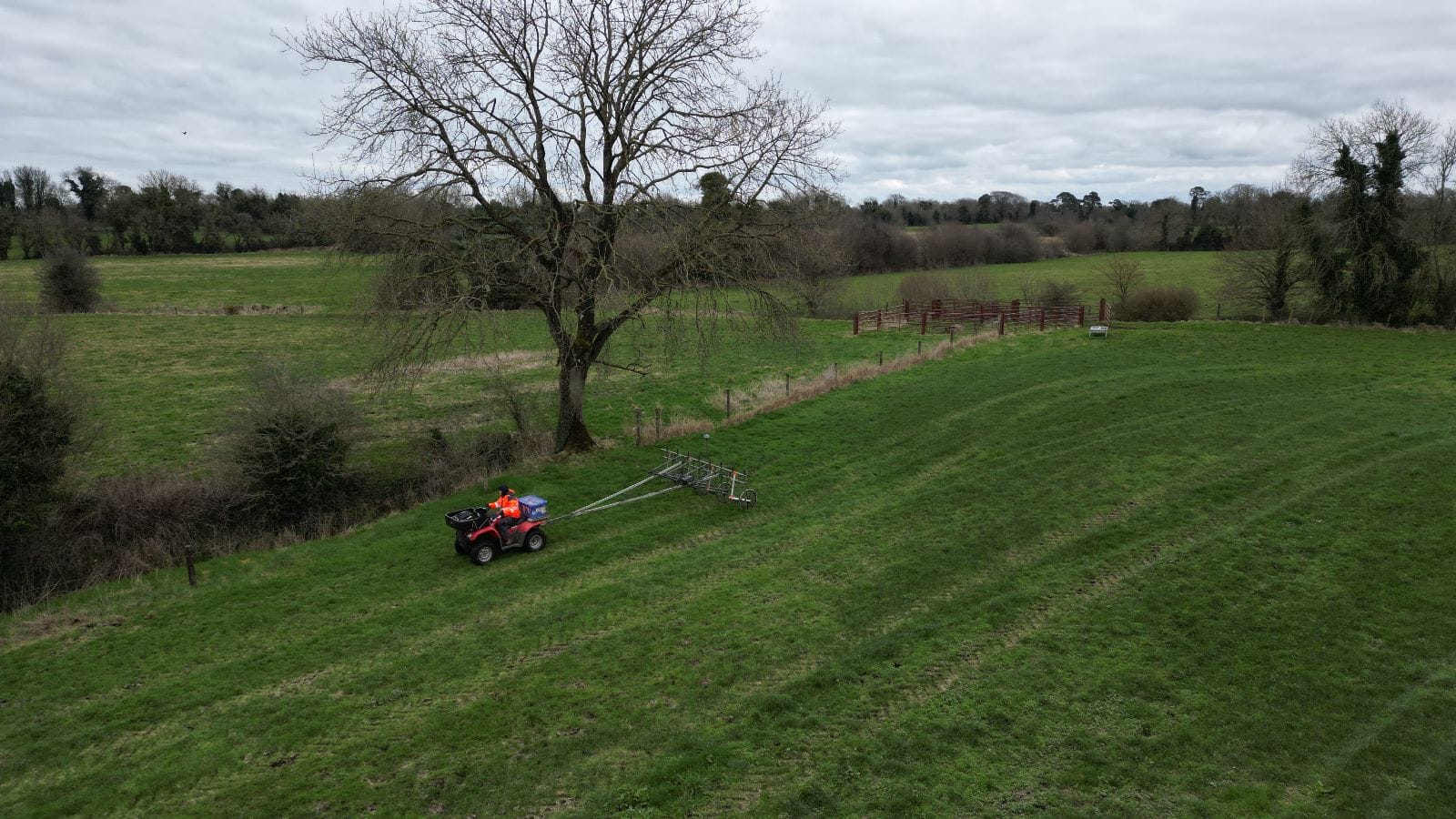
TerraDat provides archaeological geophysical survey services across Ireland, including magnetometry, GPR, and electrical resistivity. We routinely apply for and are awarded detection device licences from the NMS, and have experience on solar farm developments of varying scales. Our survey teams are flexible and scalable, allowing us to mobilise at relatively short notice.
Following data processing, we offer post-survey meetings with all relevant stakeholders — the developer, the archaeological consultant, and NMS — to present and discuss the results. This collaborative approach helps produce a trenching programme acceptable to the NMS from the outset, avoiding delays caused by later scope renegotiation.
If you are planning a solar development in Ireland and need to discuss a geophysical survey, please get in touch early. NMS licence applications typically require around four weeks — another reason to begin the conversation sooner rather than later.
Contact us: web@terradat.co.uk | +44 (0)29 2070 0127
This article is intended as general guidance and does not constitute legal advice. The regulatory position described is current as of February 2026. Developers should seek project-specific advice from their planning consultants and legal advisors.